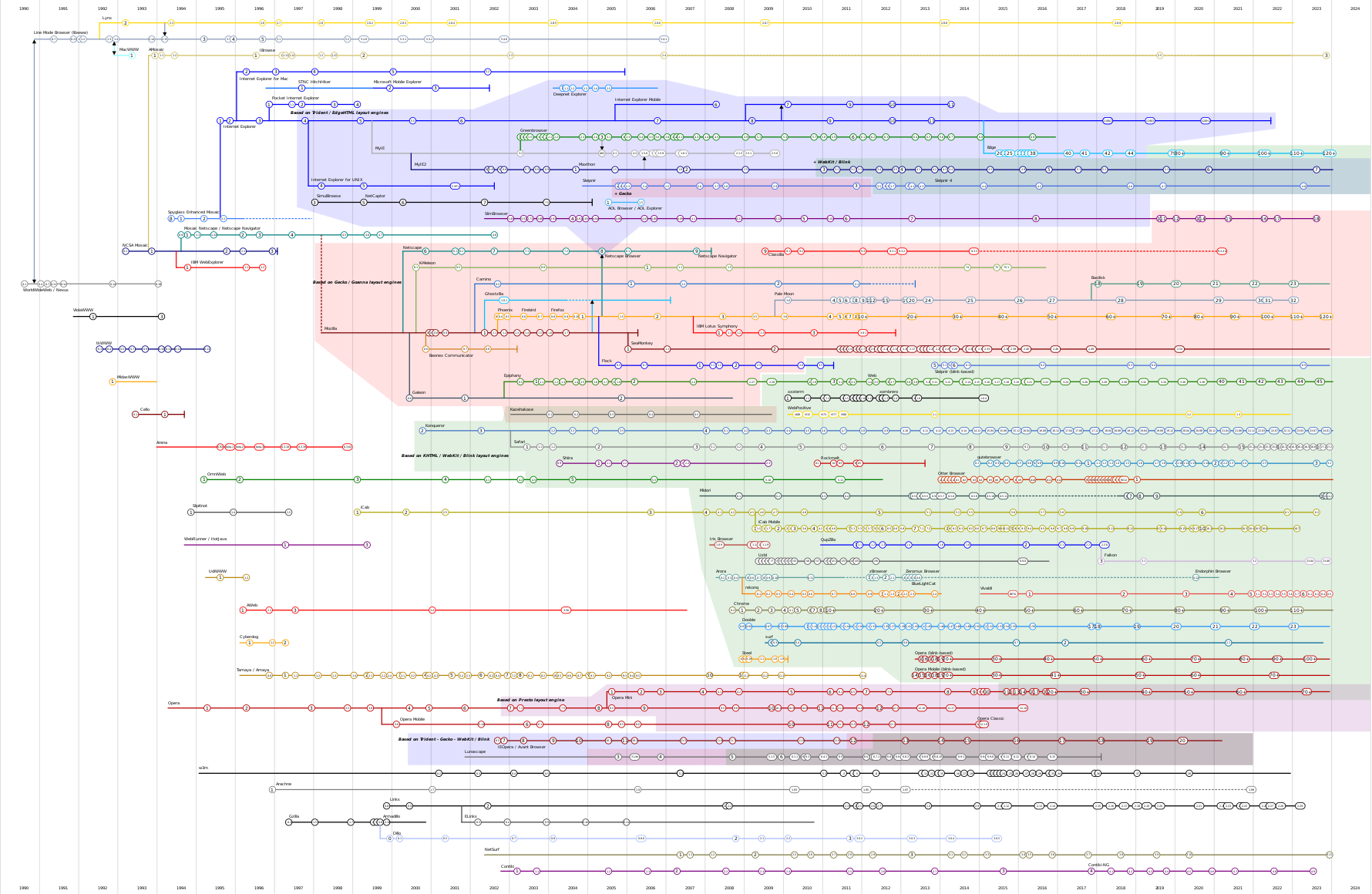
 |
| History of Web Browsers |
The Evolution of Web Technologies
The WorldWideWeb (www) was created in 1990 by Tim Bernards and Robert Cailliau at CERN when they first sucessfully tranmistted messages by the HTTP protocol.
The Protocol
The protocol for the web is HTTP where the web client requests information and the web server responds to that request.
The Server and Client Browser
The first web browser were of a monolithic design. In the mid 1990s modular designs were developed which allows us to talk about Scripting Engines, Rendering Engines and Document Object Models and the major components in a Web Browser design.Web Servers are Apache, IIS, nginx, GWS. These are mostly modular design. Web servers typically handle requests and produce responses from databases.
The Scripting Engine
Javascript was created for Netscape Navigator2.0 beta in 1995 and was soon adopted by Mircrosoft for Internet Explorer 3.0 in 1996 ECMAScript became a formal specification in 1996.
The Document Model
Each browser has a model of the document created from the source HTML input. Using scripting the document may be manipulated by code within the browser. This is Document Object Model (DOM) - Versions: DOM Level 1, year 1998, DOM Level 2, late in year of 2000.
The Rendering Engine
The Rendering Engine is a module of a Web Browser that converts a DOM into a graphic image for display. The Major Rendering Engines are Trident - Internet Explorer; Gecko - Netscape, Firefox; WebKit - Chrome, Safari; Presto - Opera.
The Problem
All the standards and implementations evolved roughly at the same time and many browser vendors did not follow the standards. The legacy is a quirky mess that drive web programmers nuts.
